Your Vans Say "24 Hour Service." Google Says You Close at 4.
The best thing we found in a search audit last month wasn't in Ahrefs. It wasn't in Search Console. It was in a photo on the company's own homepage.
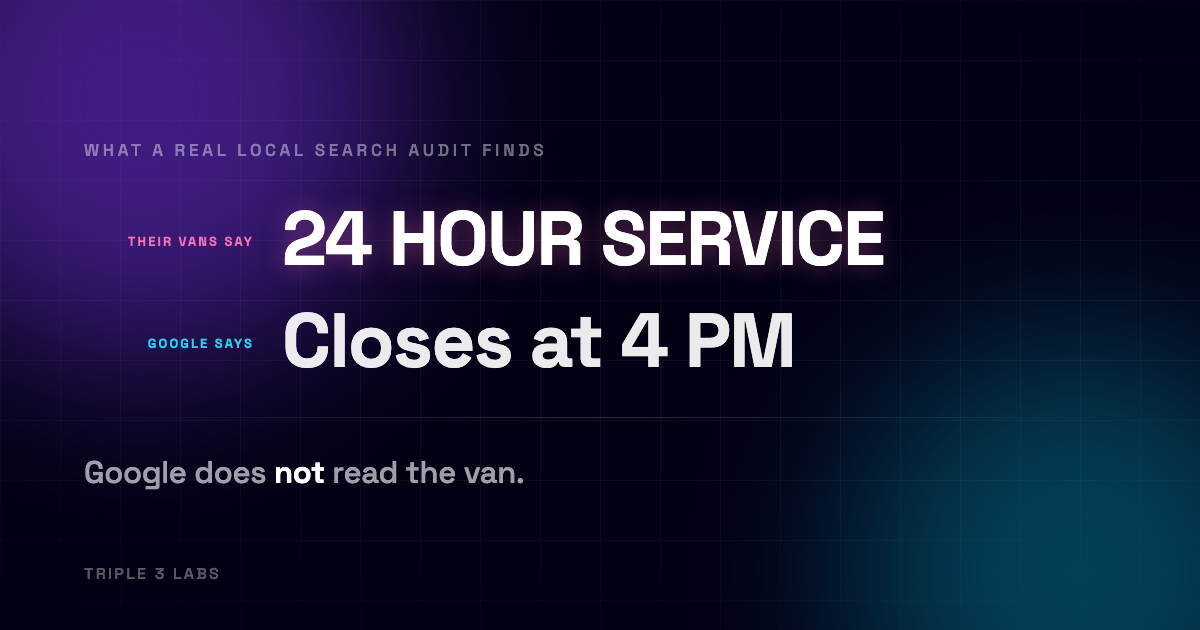
The photo showed one of their service vans. Painted down the side, in letters a foot tall: 24 HOUR SERVICE.
Then we opened their Google listing. All three offices: closes at 4:00 PM.
Every one of those vans has been driving around the county for years advertising something the business genuinely does — and every night at 4 PM, Google quietly tells anyone searching that they're closed. When somebody's furnace dies at 9 on a Tuesday night and they search for help, this company is not in the conversation. Not because they can't do the work. Because of a dropdown in a settings page nobody has opened since the listing was created.
Google does not read the van.
What we actually do in an audit
We've now run these end to end on a handful of local companies — an HVAC and plumbing contractor, a commercial glass shop, a commercial roofer. Same method every time, and it's less exotic than people expect:
- Read the entire website like a customer would, and separately like a search engine would.
- Pull the complete list of searches the business currently shows up for. Not the highlights — all of it.
- Do the same for four or five real local competitors, found by running the actual searches rather than trusting a tool's "competitors" tab.
- Open every Google listing, every Yelp page, every directory profile on a phone, and write down what they say.
- Then hunt for contradictions between what the business says about itself and what its listings tell Google.
That last step is where the money is, and it's the step most audits skip because it can't be automated. The van finding came from step five. So did "the website claims work across the whole state but never states an address anywhere on it" — a glass company telling Ohio it works everywhere, and telling Google it's nowhere.
The four numbers
Every audit opens with exactly four numbers, and they always tell the same story in the same order: what you'd expect → how invisible you actually are → the neighbor who's beating you → where the customers are going instead.
Here's how three of them came out, anonymized:
| HVAC & plumbing | Commercial glass | Commercial roofing | |
|---|---|---|---|
| Searches the company shows up for | 6 | 0 | 2 |
| …that could ever bring a new customer | 1 | 0 | 0 |
| Pages on the website | 219 | 1 | 19 |
| Pages that never appear in a search | 218 | 1 | 18 |
| Share of the search traffic going to rivals | 97% | — | 99% |
Six searches. A company in business since 1993, three offices, two hundred and nineteen pages of website, and it surfaces for six searches — five of which are its own name. It should be hundreds.
The roofer's second search is my favorite detail in any of these documents. They show up at position nine for a term that is a misspelling of a different company's name. That's the entire non-branded search footprint of a certified commercial roofing contractor with two decades of work behind them: somebody's typo.
And the glass shop's whole website is one page. One. No address, no city, no hours anywhere on it, a sitemap that 404s, stock photography, and the literal placeholder word "test" sitting live on the page next to a "Make A Payment" button. Zero backlinks — not "a few weak ones," zero, ever.
Nobody is failing. They were never aimed.
Here's the part that surprises owners, and it's the reason none of this is as bleak as the table looks.
The HVAC company's website is good. Clean build, fast, no technical wreckage. Whoever built it did honest work. It was just never pointed at the market it serves. There are 206 blog posts on that site and not one of them ranks for anything, because none of them were written about the towns and services people actually search for.
Meanwhile a competitor ten miles down the road shows up for 131 searches against their six. Not because that competitor is sophisticated. We looked. They have four templated town pages — the same page, four times, with the town name swapped. That's it. That's the whole advantage.
The gap between 6 and 131 isn't talent, budget, or technology. It's that one of them built the pages and the other didn't.
Same story at the roofer, same story in glass. In the glass market the "leading" competitor shows up for two searches and gets about thirty visits a month. The entire market is unclaimed. Whoever builds something first simply takes it.
The chapter nobody's shown them yet
We check one more thing now, and it's consistently the section owners react to hardest: how often each company gets cited when someone asks an AI assistant instead of Google.
Across ChatGPT, Gemini, Perplexity, Copilot, Grok, and Google's AI answers, measured identically for everyone in the market:
- The HVAC company: cited 3 times total, zero by ChatGPT. The competitor with the town pages: 16 times, and the only company in that market ChatGPT will name.
- The roofer: zero citations. The strongest rival: six.
- The entire glass market: zero, for every company we checked.
It's the same story as search, one chapter earlier — and nobody has claimed the ground yet. Which is genuinely good news, because every fix in a normal local search plan does double duty here. There's no separate "AI package" to buy.
If you want one
We build these for free, for businesses we'd genuinely like to work with. It takes us about a day. You get the document whether or not you ever talk to us again, and there's nothing in it you couldn't verify yourself with a phone and an afternoon.
The van is still driving around advertising 24-hour service. The listing still says 4 PM. That fix takes about ninety seconds — once somebody looks.